Artificial intelligence integration does not end with a demonstration that works in five minutes. The difficult part comes afterwards: putting the solution into the software your people already use, connecting it to your data, making errors visible and knowing its monthly cost. That is the part I implement, from AI integration into your software to AI business automation that people actually use.
Built into daily work
The feature is added to the software people already open every day. There is no separate tool to launch and remember.
Answers have sources
The solution answers from your documentation and database, and identifies the source. A business answer that cannot be checked is not useful.
No lock-in
The code, prompts and settings are yours. The model-provider account is in your name, so you see and can stop its cost directly.
Where this makes sense
These are examples of work I do, not claims about named clients. The exact benefit depends on how much work is manual today and how well the data is organised. That becomes clear only after an analysis.
Manufacturing
Customer enquiries arrive as spreadsheets and PDFs in different formats. The system reads them, recognises item codes and prepares a quotation draft for a salesperson to confirm or correct.
Logistics and transport
Scanned delivery notes, CMRs and carrier invoices can be compared with orders automatically, while only mismatches are sent to a person for review.
Construction
An assistant searches bills of quantities, tender documents and project changes, then points to the precise document and page instead of leaving someone to search folders.
Hospitality and accommodation
Reply drafts can use actual availability and price lists when enquiries arrive by email, website or booking platforms; a person reviews every draft before it is sent.
Accounting
The process can suggest an account and classification from previous postings, while uncertain cases are set aside for a person rather than guessed.
Legal work and consulting
A search over previous cases, opinions and contracts finds the passage and links to the source document, with access rules for confidential material.
What an AI integration stands on
An assistant is only as valuable as the systems underneath it. If data is scattered across spreadsheets without a common key, a model will not fix it; it will only produce incorrect answers faster. This work therefore rarely starts with the model.
Database development
Before adding an AI feature, data structure, indexes and backups often need attention. It is useful work in its own right and the foundation of a reliable assistant.
Software people use
Desktop software, Office add-ins and internal applications are where work happens. I add the AI feature there instead of creating another isolated window.
I have built databases and business software for years, so the AI feature enters a system I understand instead of sitting alongside it.
Delivered
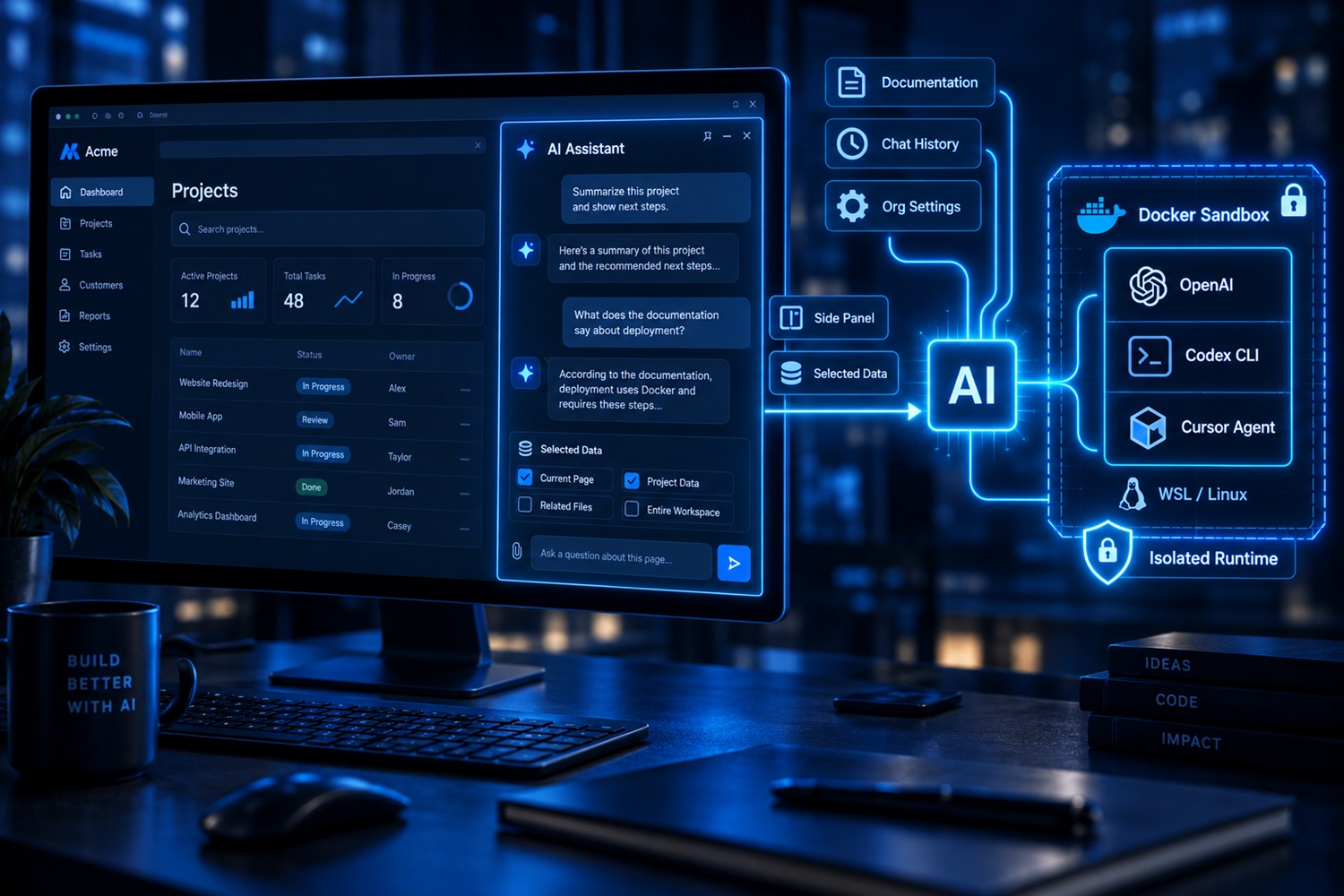
What I offer already runs in two places. An AI assistant sits next to every screen of a business web application and works through OpenAI or runs Codex and Cursor agents, without being tied to one vendor. A Microsoft Word add-in sends document text to a language model and returns it to the same document, using the customer's own API key and no middleman; the same add-in is also sold as a ready-made product with a public price.
Pricing
Prices are public so you can see the order of magnitude. The final price and deadline follow the paid analysis, because they depend on the system being integrated.
First step
AI readiness assessment
A review of your data, your systems and one specific job you want to speed up, with a written finding and a step-by-step plan.
Price 29.900 RSD ($285.96)
The analysis is ordered and paid for first. See what it covers.
Implementation work
AI integration
Automating one workflow
One job that is done by hand today — reading documents, sorting, data entry or drafting replies — moves to automatic processing, with a person checking the result.
One workflow, from the input to a result a person confirms.
- Connecting to the source the work arrives from: e-mail, a folder, a form or a database
- Processing through the model, with rules for what happens when the model is unsure
- Writing the result back into the system you already use
- A control set of examples used to measure that it works
An assistant over your own documents
Search and answers across your own documentation — contracts, manuals, quotations, regulations — with the source shown next to every answer, so each claim can be checked.
Answers from your own documentation, with a source next to every claim.
- Preparing and indexing the documents you provide
- Search that finds the passage first and only then composes the answer
- A link to the source document and page with every answer
- Access rules, so each person sees only the documents they are entitled to
- A control set of questions with known correct answers
Integration into an existing ERP, CRM or in-house application
The AI feature goes into the program your people already use, at the point where the work actually happens. No separate application to open.
Entering the system as it stands, where your people already work.
- A review of the documentation and of how the system is entered
- The feature where the work happens, with no new program to open
- A record of every model call, for cost and for checking
- Step-by-step work, paid per completed step
The price depends on the system being entered, so it is confirmed after the assessment.
After delivery
Monthly maintenance of an AI solution
Watching token cost and errors, checking answer quality against a control set, and moving to a newer model when the current one is retired. The quantity when ordering is the number of months.
Price 11.900 RSD ($113.81)
Maintenance keeps the solution useful when providers retire models, token prices change or your data changes. The complete list is on the pricing page.
First step: analysis
I do not quote a fixed price for work I have not seen. The analysis takes three working days, has a fixed price and produces a written finding that remains yours whether or not we continue.
It also says when a report, script or data cleanup would be cheaper and more reliable than a language model. The analysis is ordered first because its scope and deadline are known in advance.
AI readiness assessment
A review of your data, your systems and one specific job you want to speed up, with a written finding and a step-by-step plan.
Price 29.900 RSD ($285.96)
This amount is deducted from the implementation price if we continue. Otherwise, the finding remains yours.
What I commit to:
- I reply the same working day, the next one at the latest.
- You learn the price before, not after. A fixed price and deadline follow the assessment. If something outside the agreement comes up during the work, you hear the price before I do it.
- I fix defects free of charge for 30 days after delivery. A defect is something that does not work as agreed; a change is something you want done differently than agreed, and it is arranged separately.
- The work goes step by step, each step with its own price and deadline, paid once it is done. After every step you see the result and can stop.
- The measure is set before the work, not after. Together we define what it means for the solution to work - for example how many of twenty test cases must pass - and that is checked at the end.
- Code, prompts and settings are yours. After delivery you get the source code and everything needed to run the solution without me. Provider accounts are in your name.
- No lock-in. I build nothing that ties you to me or to a single model provider more than necessary, and I write down where a provider can be swapped.
I state this before an order so you understand the price. Work outside the agreed scope can be done, but is agreed and charged separately.
Not included in the price:
I write this so you understand the price before ordering, not after. Everything on the list is something I can do, but it is agreed and charged separately.
- Training a model of your own. I work with existing models through their API. Training a foundation model is not part of any package and I do not offer it.
- The model subscription. Tokens and the subscription at OpenAI, Anthropic or another provider are paid by you, from your own account and by your own usage. That way you see the cost directly and can stop it without me.
- Cleaning up data that is not ready. If documents exist only as scanned images, or data is scattered across tables with no common key, sorting that out is separate work. The assessment shows whether it is needed, before the price is confirmed.
- Licences and access to third-party systems. If we go into an ERP, CRM or inventory system, you provide the access, the documentation and any permission from its vendor.
- Legal review. I can align labelling and user notices with what the technology requires, but the assessment of legal risk and liability comes from a lawyer, not from me.
- A guarantee that every answer is correct. A language model can be wrong. The solution is built so that an error is visible and correctable, not so that it never happens - nobody can promise that.
Before we start, prepare:
- Access to the system we are going into - a test environment or a copy of the database, with documentation if any exists.
- One person who knows the job. They do not have to be a developer, but they must know how the work is done today and what a correct answer looks like.
- About twenty real examples. For a document assistant those are real documents; for workflow automation, real cases from recent months, including the ones that went badly.
- An account with the model provider, opened in your name. If you do not have one, we open it together during the assessment.
- A decision on what is confidential. Before we start we establish which data may leave your network, because that shapes the solution itself.
What this is not
I do not train foundation models
I work with existing models through their APIs. Training a proprietary model is different work, with different costs and equipment, and is not a service I offer.
I do not resell someone else's chatbot
I do not put my name on a ready-made platform and charge a subscription for another company's product. What I deliver is yours and can run without me.
I do not sell AI where it is not needed
Many requests labelled “AI” are better solved by a report, rule or cleaned-up database. That is classic business process automation. When that is the case, I say so.
Ownership and exit
- The code, prompts and settings are yours. After delivery you receive the source code and everything required to run the solution without me.
- Model-provider accounts are in your name. Your API key and invoice stay with you, and you can see or stop usage directly.
- Changing provider is considered. The model call is isolated in the code, with documented limits on changing it.
- Maintenance notice is symmetrical. One month for either side. Ending maintenance ends monitoring and support, not the solution itself.
Frequently asked questions
Not sure whether your work belongs here?
Describe one concrete task currently done manually and how many people do it. I will tell you whether it makes sense and, if it does not, say that too.
Send an enquiryI usually reply the same day.
Leave a Comment